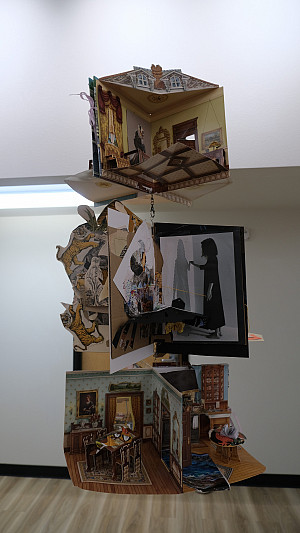
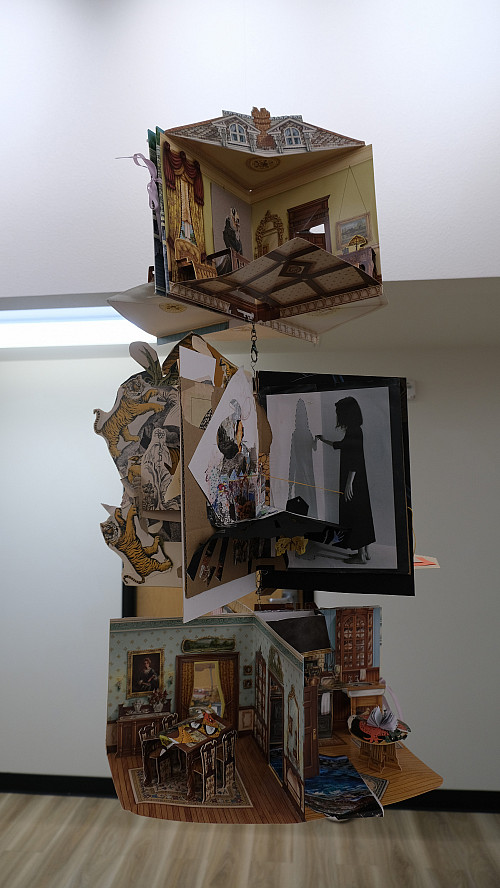
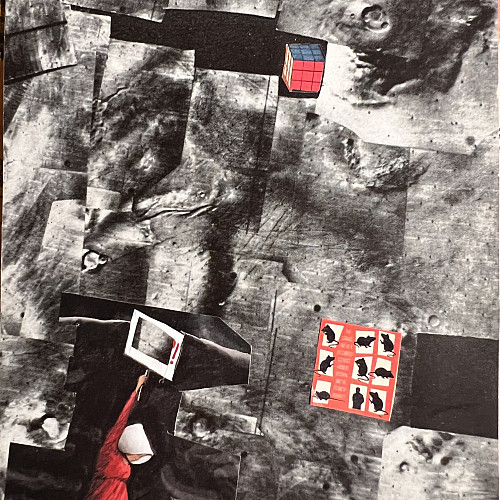
Holding Space mixed media 18x18x18” Credit: Elise L.Artist Bio
Elise Randles Levi is a middle-aged white woman who was raised within a subculture with iconoclast norms in rural and then more urban Oregon. Elise is currently completing their Masters in Art Therapy at Lewis & Clark College and recently completed a three-year training in Somatic Experiencing®. Elise received a Bachelors of Communication and Visual Information from the University of Maine Machias, and an Associate of Applied Science in Aeronautical Technology from South Seattle College. As an aircraft mechanic Elise would get the question, ‘how does an artist end up being an aircraft mechanic?’ And more recently, ‘how does an aircraft mechanic end up becoming an art therapist?’ The answer is less of a riddle, like a cat with nine lives, and more of an involutive process, like that of trees and fungi. Being neurodivergent has the implication of having divergent processes occur outside the brain, in all dimensions. This produces atypical linguistic function across schemas of art, mechanics, maps, design and interpersonal neurobiology. Elise considers being an art therapist as a highest form of self in relationship to humanity, life, craft, creativity and ideas. This is not a set state or identity, but a spiritual and ethical contract of engagement in praxis and dialog.
Artist Statement
“Conceptual artists are mystics rather than rationalists. They leap to conclusions logic cannot reach.”
Sol Lewitt, Sentence 1, from ‘Sentences on Conceptual Art’ 1969
In preconception of art, sometimes I have a set objective and the task of reaching that goal is one of craft. Sometimes, I have a set process, and the objective is to find when it is appropriate or necessary to stop. Sometimes the resultant form is seeded from misconception. Once it is, its existence belongs to the schema of the viewer, or it may be cast as outside the pale of the viewer’s schema of what art is.
For this process, I chose the form of a book but did not adhere to linear schema books are generally known for. I chose to teeter between dimensions. In process of deconstruction and reconstruction of imagery and image-relationships I selected imagery that relates– intuitively or cognitively – to my experience as an intern art therapist. My primary internship site is at a group practice which serves adults, children and families and specializes in Clarification and trauma treatment, including sexual abuse and problematic sexual behavior and sexual offence which has occurred within family systems. My secondary internship is adult inpatient psychiatric care in a hospital setting. In my work, I consider one of the most essential conditions for positive transformation from maladaptation rooted in developmental trauma is extrication from shame.
I invite the viewer to engage in the experience of parallax when viewing this work.
Holding Space
mixed media 18x18x18”xT
2025
Credit: Elise L.
Holding Space
mixed media 18x18x18”xT
2025
Credit: Elise L.
Elise L.
Art Therapy is located in room 326 of Rogers Hall on the Graduate Campus.