A Call for Strong, Stable Renewable Energy Policy in the United States

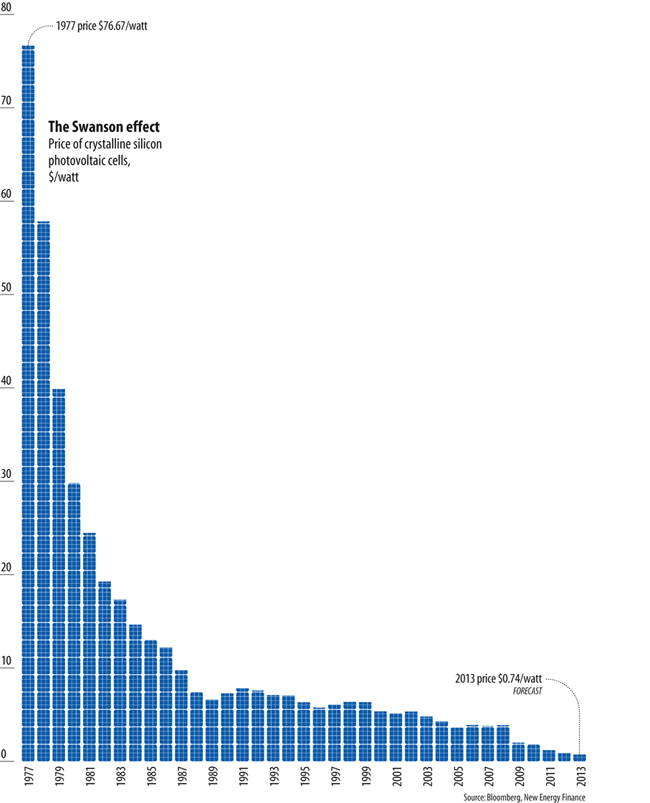
The International Energy Agency (IEA) recently released its Renewable Energy Medium-Term Market Report 2014, revealing that although 2013 witnessed the fastest expansion of renewable energy capacity to date, the IEA expects the growth of renewables to slow in coming years. Despite the fact that renewable energy is becoming more affordable (including a precipitous decline in the price of solar photovoltaics), and thus more competitive with fossil fuels, the IEA describes how an unstable policy and market framework threatens the continued fast growth of the renewable energy sector.
This threat to the growth of renewable energy is especially pronounced in developed nations such as the United States. The IEA notes that countries like the United States “face challenges to maintain regulatory frameworks” that provide financial security for investors in renewable energy. In the United States in particular, the IEA notes that “questions persist over the durability of renewable tax incentives, and heated debates are occurring in a number of states over renewable portfolio standards and rules for promoting distributed generation.” For more on how the instability of federal tax credits affects the wind industry, see Sustainable Energy Subsidies, by GEI Director Melissa Powers. For more on some of this year’s conflicts over renewable energy policies at the state level, see The War on Renewables, by GEI Staff Attorney Amelia Schlusser.
In contrast, China and other developing nations seem to be taking the lead on renewable energy development. For example, the IEA projects that non-OECD nations will “account for around 70% of new renewable power generation from 2013-20.” It also notes that “China remains the anchor of renewable capacity deployment, accounting for almost 40% of the global expansion” to date. Moreover, China is likely to dramatically increase renewable energy deployment in the near future; an ambitious plan to encourage distributed generation in China aims to add as much as 14 gigawatts of solar power by the end of 2014.
The United States should be a leader in renewable energy policy and deployment. And to be fair, we are making progress. Wind is the fastest growing source of power in the United States, and the solar industry has enjoyed record growth recently. Nonetheless, despite the solar industry’s record growth in the United States, the IEA reports that in absolute terms China and Japan were last year’s leaders in solar deployment. To reclaim a position of leadership in renewable energy, federal and state governments in the United States should adopt a strong, stable policy framework to support renewable energy development. The Green Energy Institute plans to help design this policy framework; stay tuned for future blog posts and publications on how the United States should move forward.
Green Energy is located in Wood Hall.
email gei@lclark.edu
Director
Carra Sahler
Green Energy
Lewis & Clark Law School
10101 S. Terwilliger Boulevard MSC
Portland OR 97219
More Stories

POWER Act Implementation: Comparing Approaches to Data Centers in PGE and PacifiCorp Territory
Governor Kotek signed HB 3546, Oregon’s POWER Act, into law on June 16, 2025. Implementation in territory served by Portland General Electric and in parts of Oregon served by Pacific Power (aka PacifiCorp) looks different.

NW Energy Coalition Conference - October 15
Join the NW Energy Coalition for the Fall 2026 conference
October 15, 2026
9 am to 5 pm
The University of Washington HUB – Seattle, WA
Register here

Regulating the Rise of Data Centers in Oregon
Green Energy Institute staff and students are advancing solutions under Oregon’s POWER Act to address the environmental and economic impacts of data center expansion. The Oregon Public Utility Commission’s recent ruling, citing GEI throughout, ordered some of the most innovative and protective outcomes from a public utility commission in the nation.

Lewis & Clark College Ushers in PNW Climate Week with a Major Conference, and a Question
As Portland’s first-ever PNW Climate Week began, more than 100 youth leaders, advocates, and community members gathered at Lewis & Clark to imagine a thriving, sustainable future—and explore the actions needed to make it a reality. Through hands-on workshops and cross-generational conversations, the event highlighted Lewis & Clark’s leadership in climate education, policy, and innovation.
Watch the recording of the keynote provided by Graham Zimmerman at Protect Our Winters here.